
Does Lubricant Gel Affect Pig Semen During Artificial Insemination?
Artificial insemination is a routine part of modern pig breeding. Most commercial breeding programs use preserved boar semen, which means semen handling and insemination technique can directly affect reproductive results.One detail that is sometimes overlooked is the lubricant used on the insemination catheter.So, does lubricant gel affect pig semen during artificial insemination?
It can. The main concern is not simply whether a gel is a lubricant, but whether its formulation is suitable for contact with reproductive tissues and whether it can come into contact with the semen dose.For swine AI, a non-spermicidal lubricant is generally recommended. However, the way the lubricant is applied is just as important as the product itself.
Why Does Lubricant Matter in Pig Artificial Insemination?
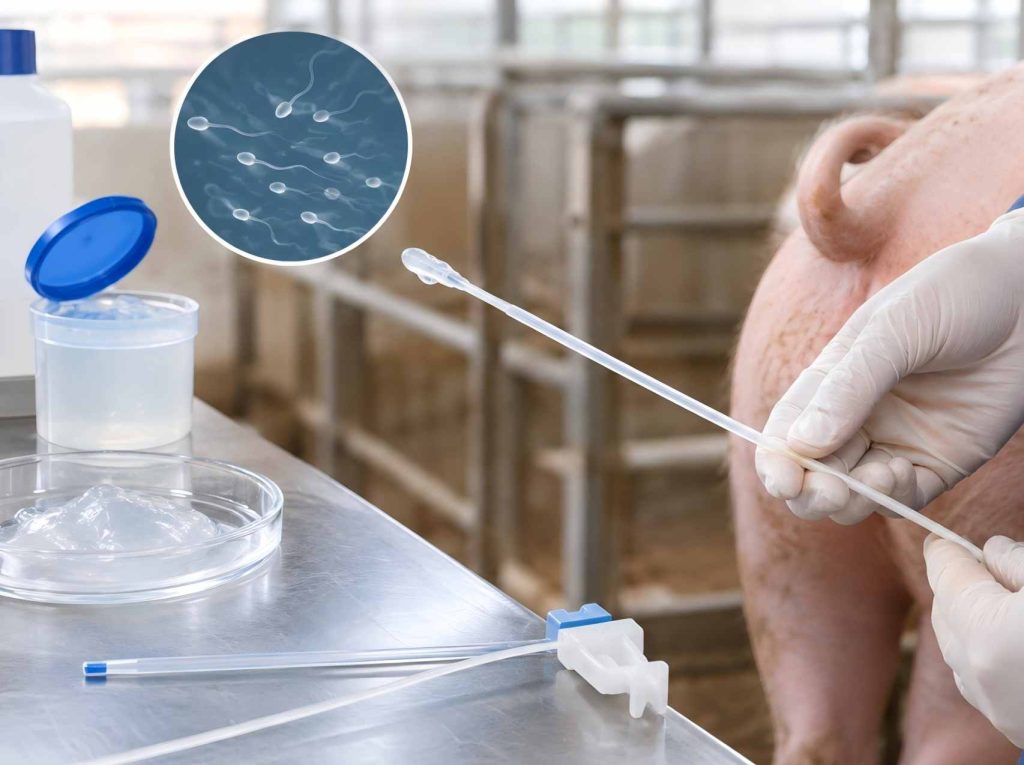
During sow artificial insemination, the catheter needs to pass through the vulva and vagina and reach the cervix. A small amount of lubricant can make insertion smoother and reduce friction.The problem occurs when a lubricant that is not intended for reproductive use comes into contact with sperm.Sperm cells are sensitive to their surrounding environment. Their motility and viability can be affected by temperature, storage conditions, dilution, chemical exposure and handling. These factors are particularly important with liquid-preserved boar semen, which is commonly used for pig AI.
For this reason, the lubricant should not be treated as an ordinary household gel. A product used during pig artificial insemination should be selected with sperm compatibility in mind.
What Is a Non-Spermicidal Lubricant?
A non-spermicidal lubricant is designed without ingredients intended to kill sperm.This is one of the most important characteristics when choosing a swine insemination lubricant. Extension recommendations for pig breeding specifically advise using a non-spermicidal lubricant on the catheter.Some veterinary reproductive lubricants are also described as water-soluble, sterile and non-spermicidal. These characteristics are intended to provide lubrication without unnecessarily interfering with the semen or reproductive procedure.
However, “non-spermicidal” should not be interpreted as meaning that the gel should be mixed directly with semen. The practical goal is to use enough lubricant to assist catheter placement while keeping unnecessary lubricant away from the semen dose.
Can Lubricant Reduce Pig Sperm Motility?
The potential effect depends on the formulation and exposure.Different lubricants can contain different combinations of water, glycerol, polymers, preservatives and other ingredients. If a product is not designed for reproductive use, its chemical properties may not be appropriate for sperm.For pig AI, the safest approach is to select a sperm-safe lubricant specifically intended for veterinary or reproductive procedures.At the same time, lubricant is only one of many factors affecting pig semen quality. Storage temperature, transportation, dilution, storage time and handling can also influence sperm motility and viability.
This means that a drop in semen quality should not automatically be attributed to lubricant.
How Should Lubricant Be Applied to a Pig AI Catheter?
Correct application is simple but important.Before insemination, the vulva should be cleaned to reduce the chance of introducing dirt or contamination into the reproductive tract. A small amount of veterinary lubricant gel can then be applied to the tip of the catheter.
Importantly, the lubricant should not be allowed to enter the opening of the catheter.
Swine AI guidelines from Texas A&M and the University of Missouri both specifically recommend lubricating the catheter while avoiding lubricant in the catheter opening.
The reason is straightforward: the catheter is eventually connected to the semen dose. Keeping lubricant away from the opening reduces unnecessary contact between the gel and semen.
For spiral catheters, the tip is gently guided toward the cervix and rotated to engage the cervical folds. The semen container is generally attached after the catheter has been positioned, depending on the catheter system and farm protocol.
What About Deep Insemination in Sows?
The same principle applies to post-cervical or deep cervical artificial insemination.Because the catheter system is different, careful handling becomes even more important. Research involving deep cervical AI in gilts has described lubricating the catheter tip with a non-spermicidal sterile gel before insertion.
The lubricant is there to help the equipment pass through the reproductive tract. It is not intended to become part of the semen dose.
For farms using a pig AI catheter, the lubricant should therefore be applied in a controlled way according to the catheter manufacturer's instructions.
Other Factors Can Affect Pig Semen Quality
It is easy to focus on lubricant when evaluating semen quality, but several other factors are usually more important.Semen temperature
Boar semen is commonly stored under controlled conditions. Temperature fluctuations during storage and transportation can influence sperm quality.
Storage time
Liquid-preserved semen has a limited useful storage period. Longer storage can affect sperm characteristics depending on the extender and storage conditions.
Handling
Excessive shaking, unsuitable temperatures or poor handling can reduce semen quality.
Catheter contamination
Clean equipment is essential. Queensland Government guidance notes that boar semen supports bacterial growth and recommends careful cleaning and storage of reusable equipment.
Lubricant selection
Finally, the lubricant should be non-spermicidal and suitable for artificial insemination.
These factors work together, so good AI management requires more than simply choosing a lubricant.
How to Choose a Lubricant for Pig AI
When purchasing a pig artificial insemination lubricant, buyers should consider more than viscosity or price. Important specifications include a non-spermicidal, water-soluble formulation, suitability for animal reproduction, compatibility with AI catheters, appropriate viscosity, clean and controlled packaging, proper storage requirements, shelf life, and clear instructions for use. Packaging size should also match the operation: commercial pig farms may prefer bulk containers, while veterinary clinics and smaller farms may choose smaller packages for easier handling and replacement.Conclusion
So, does lubricant gel affect pig semen during artificial insemination?It can, particularly if an unsuitable product comes into contact with semen. However, the greater practical concern is selecting an appropriate non-spermicidal lubricant and applying it correctly.
For sow artificial insemination, lubricant should be used primarily to help the catheter pass smoothly through the reproductive tract. A small amount on the catheter tip is generally sufficient, while the catheter opening should be kept free of excess gel.
Semen quality itself depends on many factors, including storage temperature, storage time, transportation and handling.
For farms using conventional, cervical or deep cervical AI, choosing a sperm-safe veterinary lubricant gel and following proper catheter handling procedures can make this small part of the insemination process more controlled and consistent.
Get the best quote and sample information.
Fill out the form to get sample information or inquire for more information.